Read next
The latest news, updates and expert views for ambitious, high-achieving and purpose-driven homeowners and property entrepreneurs.

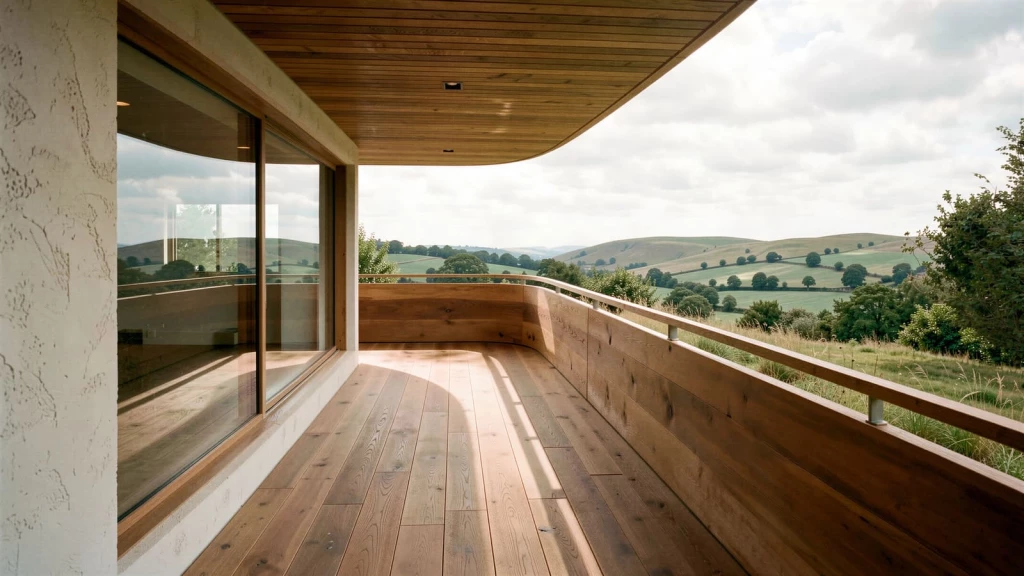
Designing in the countryside is never just about the building. It is about the land, the views, the materials, the construction method, the local economy, and the long-term story a project is trying to tell.
Where the scheme is a rural holiday home, planning permission is rarely won on design alone. The story has to hold up on three fronts at once: a sound planning strategy, real sensitivity to the landscape, and a clear commercial case.
That is what makes The Ridge such a compelling project. A new exclusive-use homestay in the Malvern Hills, it is the work of Peter Markos of Markos Design Workshop.
Following our earlier conversation with Peter on tiny homes, we return to the countryside with a broader question: how do you create a rural retreat that feels both architecturally distinctive and entirely at home in its landscape?
Here, the discussion moves beyond compact living to the more complex world of rural holiday homes, where planning strategy, off-site construction, landscape sensitivity and commercial viability all have to be considered together. The ambition is not simply to create a beautiful place to stay, but to shape an experience that feels rooted, refined and quietly memorable.
We interviewed Peter to draw on his perspective as both an architect and the operator of a successful countryside retreat, exploring what it takes to turn a rural site into a destination without losing the very qualities that make it special.

The Monocoque Cabin is a unique architectural structure, a small cabin that we rent out on Airbnb. It garnered considerable interest both as a work of architecture and as a place to stay.
That demonstrated something critical: the importance of unique design in the commercial success of an exclusive-use homestay. The more unique the design, the more likely it is to be rented out, and the higher the customer demand.
That concept has informed The Ridge, a proposed four-bedroom homestay, but the principles have stayed the same. Uniqueness is critical, and so is good design.
The distinction between a custom home and a holiday home is quite critical from a planning perspective.
In a lot of National Landscapes, it may be very difficult to gain planning permission for a new custom home. In some cases, it is frankly impossible. Paragraph 84 can be a good route on certain sites, particularly where the proposal is being advanced as an isolated home of exceptional architectural quality, but it does carry risks and challenges.
It is a subjective policy, and much depends on the site, the design quality, the planning case and, ultimately, the judgement of the local authority or planning committee.
Paragraph 88, on the other hand, may provide a more appropriate route where the proposal is genuinely a rural tourism or leisure project rather than a conventional new dwelling in the countryside. It supports rural business growth, rural diversification and sustainable rural tourism development, provided the proposal respects the character of the countryside.
That does not mean any isolated holiday home will automatically be acceptable. You still need a robust planning case, a clear business rationale, evidence of demand, and a design response that is sensitive to the landscape.
But for a unique holiday accommodation scheme that forms part of rural diversification, Paragraph 88 can sometimes be a stronger and more realistic route than trying to present the project as a private custom home.
In this instance, we worked with the client to refine the project brief. They liked the idea of keeping their existing home on the same site and having a separate holiday home, which they can periodically use themselves as well as rent out to generate a second income as they move towards retirement.
Where people often go wrong with planning is the misunderstanding that a holiday home does not require planning permission at all, or that it automatically comes under permitted development.
I have read several articles online making this claim, and I would say that is almost certainly not the case.
Do not assume the planning classification of your site based solely on an article you have seen online. Either check yourself and be sure of it, or speak to a professional architect or planning consultant who knows what they are doing and can guide you accordingly.
It is a complicated system, and misinformation does not help.
Paragraph 88 supports diversification of the rural economy. However, the burden of proof that it genuinely supports rural tourism is quite high.
You need a business plan, proof, and a demonstration of the level of demand that is actually required. You cannot just buy a plot of land and claim rural diversification. It does not work like that.
For example, let’s say you want to build a unique homestay. Are there any ways of accessing the homestay other than by car? Are there walking, cycling or bus routes nearby?
All of these are important considerations that the council will weigh before determining whether they would actually support the planning application.
I do not understand why the C5 class has not been integrated.
For context, for people who may not know, planning for a holiday accommodation is currently subject to either C1, C3 or sui generis, depending on the scheme, land and local authority. C5 was proposed under the last government, but as of yet, it has not been included in a revised NPPF.
As such, there is currently way too much vagueness around holiday lets. Some people do not know whether they need planning permission. They almost certainly do. However, they do not know which planning routes they need to follow.
C5 would help clarify this confusion.
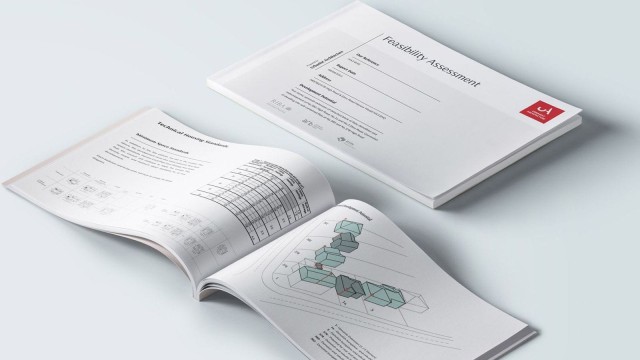
I would say do a feasibility study. You will be best served by that.
Part of the feasibility study would look at which part of the site is most likely to get planning approval, along with other key considerations.
This is one of those things where you need to go slow before you go quick. If you assume too much about what is likely to get planning permission, or whether the proposal falls under C1, C3 or sui generis, that will cause problems later on.
Do not just jump into one option. It could be a holiday home. It could be a custom home. Each carries its own pros and cons, and it is really important to make an informed decision.
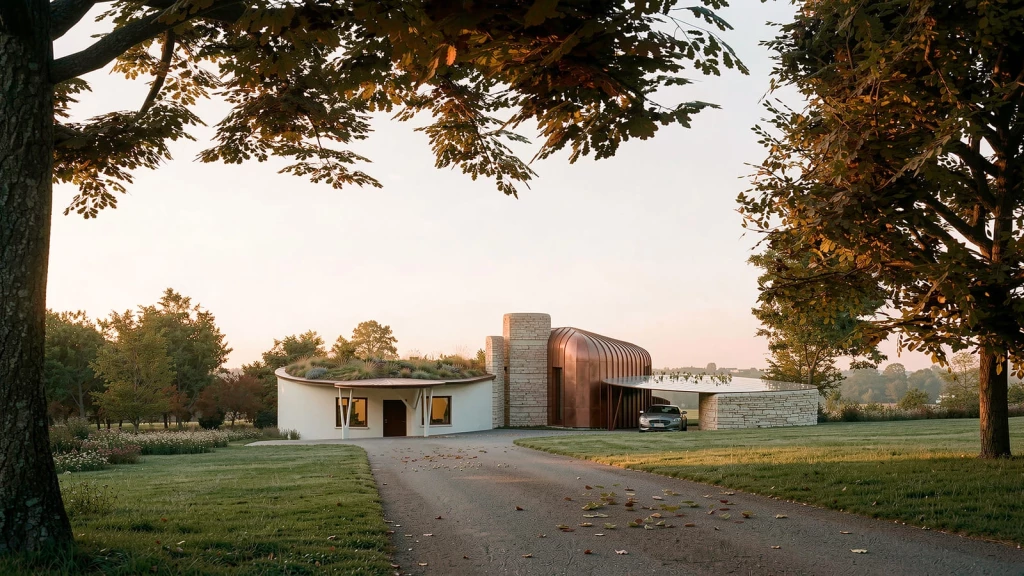
The Malvern Hills have a very distinct stratification and gradient, so designing a structure that worked with the landscape was key.
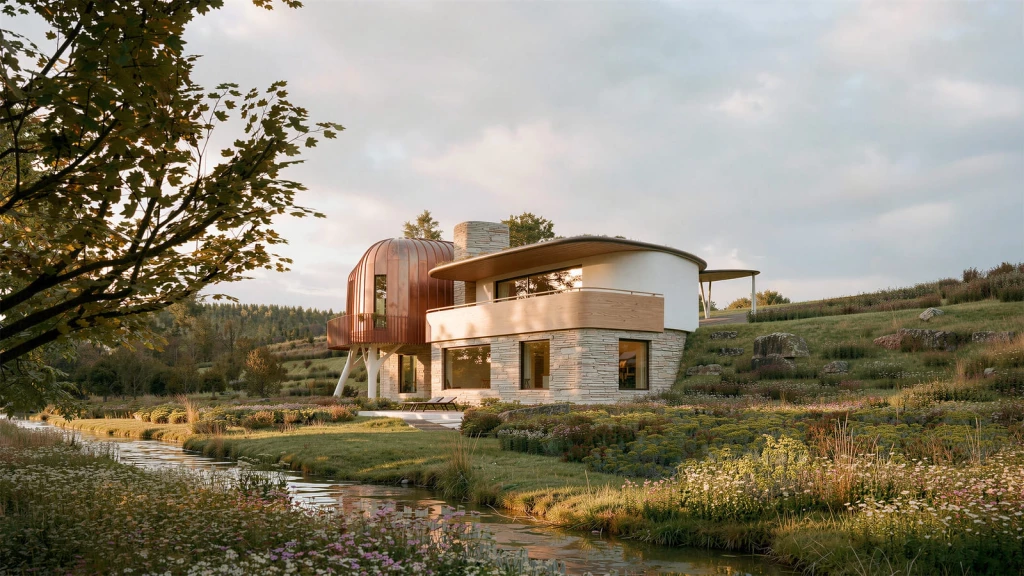
From the high point, the proposed building is designed to read as a single-storey homestay. However, where the ground descends and the home benefits from a certain sense of privacy, it widens against the landscape and reads as a two-storey space.
It is about responding to the gradient, but also the material palette of the place.
This was made easier by the site’s location in the Malvern Hills, which has a quite distinct material palette, particularly Malvern stone, which is a vernacular and local source material that blends naturally with the surroundings.
Silver timber also works well against the stone in the local context. Copper was chosen as perhaps not the most obvious material, but what we loved about it is that it reflects the surroundings through the lustre of the material. This means that the homestay looks different throughout the day.
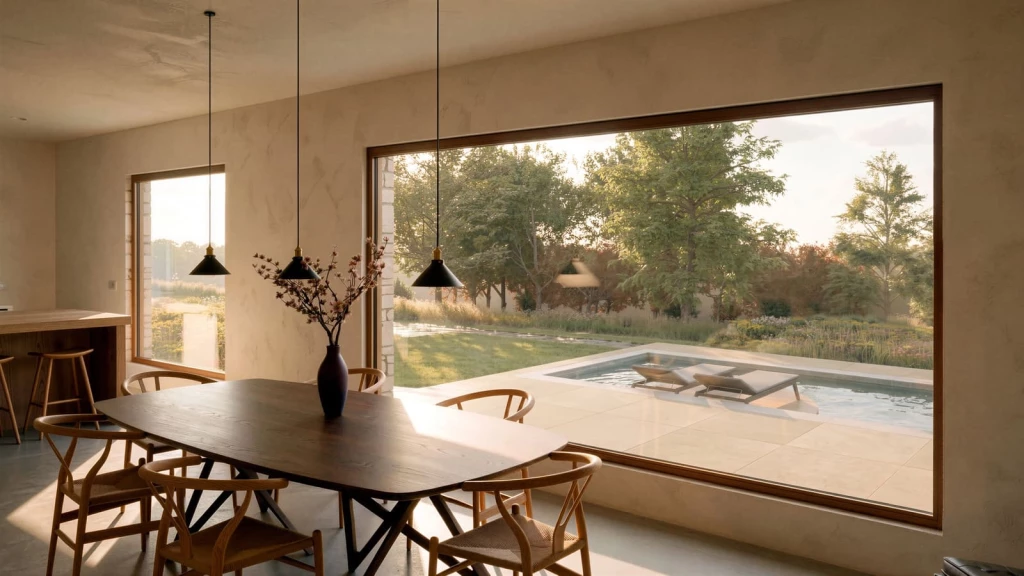
We also used hemp as an insulation material because it was key in making the space feel natural. There has been a lot of research around the off-gassing of synthetic materials and plastics used in buildings, and we really wanted to avoid synthetic materials.
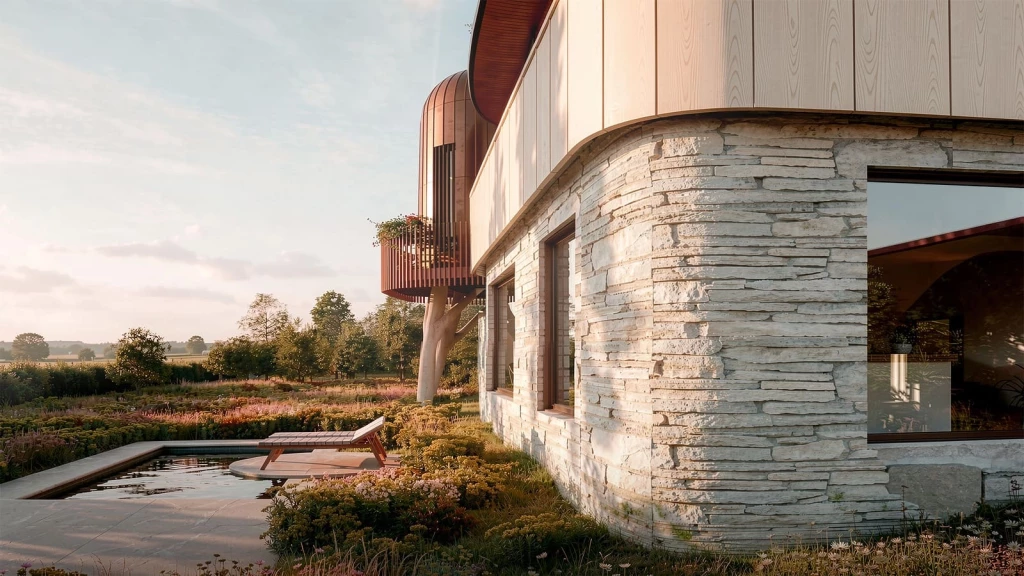
The hundred-year test is something we strive to achieve on all our projects.
There may be a slight increase in upfront cost in terms of materials and construction, but over the long term, the work can actually become significantly cheaper as well as better.
This approach is very much based on the economic theory of “Boot Theory economics”. The basic premise is that a person who buys a more expensive pair of leather boots might keep those boots for more than twenty years, whereas someone who buys a cheaper pair of trainers may only have them last a couple of years and require replacement.
It is very much the same with how we design, and we think this is also our approach to sustainability: consideration of longevity over expedience.
It is quite sad to see buildings that are only ten to twenty years old knocked down. This is quite common in the West Midlands, where we are based. I would argue that something like St Paul’s Cathedral or the Pyramids represents the ultimate example of buildings achieving sustainability.
It means I can genuinely empathise with the commercial constraints and realities of running a rural holiday accommodation business. I have a sharp sense of what actually matters in a unique holiday home design.
Take The Ridge: the sauna has been designed as part of the main structure rather than bolted on as an add-on. From experience, an intervention like that pays for itself quickly, because demand for sauna spaces is so high. That is exactly why we wanted it built into the main structure.
The other advantage of running a rural homestay business is the constant feedback from guests who have stayed at the Monocoque Cabin. The technical term is “post-occupancy evaluation”, and this level of it is genuinely rare. On most domestic projects, continual feedback like this is almost unheard of.
We are learning, almost daily, how to make things better.
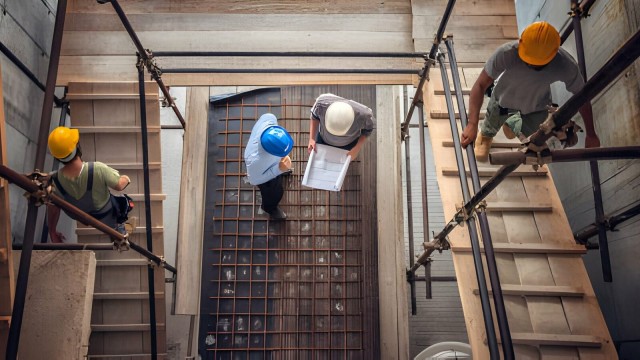
There was not one reason we opted for off-site construction. Like many things, it involves a range of reasons.
The client lives on-site and was quite concerned about the constant construction work ongoing. There are planning restrictions around how long construction can take in the local area, plus working hours restrictions. And as we know in the UK, winter can be extreme, especially in recent years, with significant rainfall.
Modern methods of construction and off-site building made sense. Off-site construction is also how we work as an architecture practice. It is our background. We have operated this way for years.
Off-site construction offers more certainty on cost, allows greater control of the timeline, and allows for greater quality control. Things are made in a factory with controlled lighting, controlled heating and a dry environment. A lot of the work is done by machines.
One of the biggest challenges, and I hope we have got it right, is designing the space so it does not look like it was designed in a factory. That is often the case with factory-built homes.
The use of real, organic materials such as stone, hemp insulation, silvered larch and copper means the space does not look factory-designed or factory-built. I feel we have got this right on past projects.
Do not let the tail wag the dog.
This will likely be one of the highest expenditures you will ever make, and I am constantly shocked to see decisions made on a whim that are later heavily regretted and become quite costly.
If you are yet to purchase a site, it is worth speaking with a good architect who can guide you through the possibilities of the land you are looking to purchase.
Know the opportunities in front of you before you commit to one route.
The Ridge offers a thoughtful insight into the kind of care, evidence and imagination that rural holiday accommodation often requires.
From rural diversification and landscape sensitivity to off-site construction, material longevity and the commercial realities of running a homestay, Peter’s reflections reveal just how many layers sit behind a proposal of this kind.
For landowners, the lesson is clear. Whether you are exploring an exclusive-use homestay, a rural tourism venture, a one-of-a-kind countryside retreat or a carefully considered project in the Green Belt, the process needs to begin long before the first drawing is produced. It begins with understanding the land, the planning route, the landscape character and the story the proposal needs to tell.
Beautiful architecture matters, but in the countryside it is rarely enough on its own. The strongest proposals combine design ambition with evidence, restraint, commercial clarity and a deep respect for place.
If you would like to learn more about The Ridge, the Monocoque Cabin or sustainable countryside homes more broadly, don’t hesitate to reach out to Peter and the Markos Design Workshop team.
We look forward to learning how we can help you. Simply fill in the form below and someone on our team will respond to you at the earliest opportunity.
The latest news, updates and expert views for ambitious, high-achieving and purpose-driven homeowners and property entrepreneurs.

We specialise in crafting creative design and planning strategies to unlock the hidden potential of developments, secure planning permission and deliver imaginative projects on tricky sites
Write us a message