Read next
The latest news, updates and expert views for ambitious, high-achieving and purpose-driven homeowners and property entrepreneurs.



Matthew Pennycook's speech at UKREiiF 2026 matters because it shows a clear shift in government tone.
This was not simply another speech about planning reform. It was a speech about delivery pressure.
The Housing and Planning Minister spoke as if the first phase of reform is now largely in motion: mandatory housing targets, Green Belt and Grey Belt reform, a restructured National Planning Policy Framework, the Planning and Infrastructure Act, the New Towns Programme, statutory consultee reform, planning committee reform, the National Housing Bank, the New Homes Accelerator, the Small Sites Aggregator, pattern book housing and a more active role for Homes England.
The phrase that matters most is his commitment to making sure 'the new system delivers'. That line tells us where the government thinks the debate has moved. The question is no longer only whether the planning system should approve more homes. It is whether the system can turn those approvals into real homes, in real places, with real infrastructure.
That distinction is crucial.
Britain's housing crisis will not be solved by paper permissions. It will be solved when permissions become starts, starts become completions, and completions become well-designed, well-located and genuinely deliverable homes.
That is a much harder test.

It would be unfair to say nothing has changed. The government has moved quickly and forcefully.
The December 2024 NPPF restored and raised mandatory housing targets, strengthened brownfield policy and introduced a modernised, strategic approach to Green Belt land designation and release. In his UKREiiF speech, Pennycook described the reforms as part of the 'most rapid, holistic and radical overhaul of the housing and planning system in decades'.
There is substance behind that claim. The Planning and Infrastructure Act is being used as the vehicle for speeding up infrastructure consents, modernising planning committees, supporting strategic planning, creating environmental delivery mechanisms and reducing procedural risk for nationally significant infrastructure.
The government is also preparing a final revised NPPF for summer 2026. Compared to the NPPF 2024, this is expected to move further towards a more rules-based approach to plan-making and decision-making, with the aim of reducing ambiguity, improving consistency and making it clearer how national housing priorities should be applied in practice.
Alongside this, ministers have attached housing delivery to a wider growth agenda: new towns, public land, social and affordable housing grant, construction skills, Homes England regional delivery and attempts to unlock small brownfield sites.
This is not minor administrative tidying. It is an attempt to rewire the housing delivery system.
But changing the rules is not the same as building the homes.
The policy direction is now clear. The government wants a more pro-delivery planning system, a stronger public delivery arm, a larger affordable housing programme and a more interventionist approach to stuck sites.
This matters because, for too long, the housing debate has treated planning permission as the main event. In reality, permission is closer to the start of the hard work than the end of it.
A new policy framework may open the door. It does not buy the land, fund the drainage, discharge the conditions, secure Gateway 2 approval, appoint the contractor or make buyers confident enough to reserve homes.

The government's ambition to deliver 1.5 million homes over the Parliament is extremely ambitious.
The latest official housing supply figures show why. In 2024-25, England delivered 208,600 net additional dwellings, a 6% decrease on 2023-24. Of those, 190,600 were new-build homes, with the remainder coming from change of use, conversions and other gains, offset by demolitions.
To deliver 1.5 million homes over five years requires an average of roughly 300,000 net additional homes per year in England. The current level is materially below that. The gap is even more acute in areas where councils cannot demonstrate a five-year housing land supply, because the issue is not simply whether more homes are needed, but whether there are enough deliverable sites capable of coming forward quickly.
The OBR has been more optimistic than many industry commentators, forecasting that planning reforms could lift housebuilding substantially and lead to the highest level of housebuilding in 40 years by 2029-30. Pennycook cited the OBR estimate that NPPF changes alone could boost GDP by £6.8 billion by 2029-30.
But even positive forecasts do not remove the timing problem. Policy changes may improve future supply, but they rarely produce completed homes immediately.
The planning statistics tell a mixed story. In the year ending September 2025, English planning authorities received 327,000 planning applications, decided 303,200 and granted 263,600. The overall grant rate was 87%, while the grant rate for residential decisions was 76%.
Yet permissions for new homes remain weak. Official figures for the same period recorded permissions for around 208,000 homes in the year to September 2025, down from around 245,000 a year earlier.
So the system is facing two problems at the same time. It is not producing enough permissions for the scale of need, and even when permissions are granted, many schemes do not move quickly into construction.

Planning approvals matter. They are necessary. They can unlock land value, provide confidence, support investment and allow design teams to move into technical delivery.
But approvals alone do not build homes.
A housing scheme can have planning permission and still be stopped by viability, section 106 delay, pre-commencement conditions, utilities, highways, drainage, abnormal ground costs, funding terms, contractor pricing, building safety regulation or weak market demand.
That is why the Minister's reference to supporting 'consented sites that are struggling' is so revealing. It is an admission that the housing crisis is not only a planning approval problem. It is also a post-permission delivery problem.
A development does not move from consent to completion by magic. After planning permission, the project team may still need to complete a section 106 agreement, finalise reserved matters, discharge conditions, resolve utilities, obtain technical approvals, satisfy building control, procure a contractor, secure finance, and manage sales or affordable housing transfer agreements.
In architectural terms, planning permission is often only the end of RIBA Stage 3, where the design has been coordinated enough for planning but is not yet ready to build.
The project still has to move through RIBA Stage 4, where the technical design, building regulations drawings, tender drawings, construction information, consultant inputs, specifications and building regulations strategy are developed in detail.
Only then can the project realistically move into RIBA Stage 5, where construction begins on site. In other words, planning consent may confirm the principle of development, but it does not remove the technical, regulatory and commercial work required to make the scheme buildable.
On higher-risk buildings, Gateway 2 can add a further major stage before construction can begin. Industry commentary has repeatedly warned that delays in the Building Safety Regulator process are becoming a delivery issue in their own right, particularly for urban and high-density schemes.
This is why Britain should stop treating permission as the finish line. Housing delivery is a chain of interdependent decisions. The chain is only as strong as its weakest link.
One of Pennycook's most useful phrases was 'removing grit from the planning process'. He linked this directly to making sure 'the application journey is as fast and easy as possible'.
That phrase matters because it moves the debate away from the simplistic idea that planning delay only happens because councils say no.
In practice, delay often sits in the grit: late consultee responses, repeated requests for additional technical information, over-complicated conditions, unresolved section 106 agreements, biodiversity net gain, building safety gateways, utilities, highways modelling and legal process.
This is not always anyone's fault. But it is often nobody's responsibility to resolve quickly.
Statutory consultees exist for good reasons. Development should be safe, properly drained, connected, ecologically responsible and technically sound.
But a consultation system that produces late holding objections, disproportionate information requests or duplicated technical requirements can quietly delay delivery without ever producing a formal refusal.
The government is therefore right to ask whether statutory consultation is always necessary, proportionate and timely. That is not an argument for removing expert advice. It is an argument for making expert advice usable within a delivery system.
The same applies to planning conditions. Conditions should make development acceptable. They should not become a second planning application by stealth.

Planning reform will fail if local planning authorities do not have the people, expertise and resources to implement it.
This is the least glamorous part of the housing debate, but it is one of the most important.
Recent industry reporting, drawing on RTPI evidence, has highlighted serious workforce pressures: one in five planners intending to leave or retire within three years, many authorities carrying vacancies, and nearly two-thirds of planning teams reporting that they lack the capacity to meet demand.
The problem is not only numbers. It is experience.
A planning system expected to handle Grey Belt assessments, viability reviews, biodiversity net gain, design codes, infrastructure planning, nutrient neutrality, community consultation and legal risk cannot be run on goodwill and agency cover.
My view is simple: planner capacity should be treated as national infrastructure.
If we would not expect a transport system to run without engineers, we should not expect a planning system to run without planners.
Pennycook's reference to helping consented sites that are struggling is one of the most important parts of the speech.
It acknowledges a reality that developers, landowners and planning consultants understand well: permission does not remove risk. Sometimes it creates a new kind of risk.
A site may have planning permission but still be undeliverable because construction costs have moved since the scheme was designed, sales values no longer support the appraisal, affordable housing obligations are too heavy for the current market, infrastructure requirements are front-loaded, abnormal costs emerge, lenders are nervous, or contractors price in uncertainty.
Sometimes the problem is not one dramatic obstacle. It is a slow accumulation of friction.
This is the uncomfortable truth every housing minister faces: large-scale housing delivery takes a long time, often longer than a single term of government.
A five-year Parliament is not a long time in a system where a larger housing scheme may take one year or more simply to source and agree the purchase of a site. It may then take 6 to 12 months to work up a design capable of being submitted for planning. A complex scheme requiring a full Environmental Impact Assessment can easily add another six months before a complete application is ready.
Planning itself can take 3 to 12 months, and longer where a section 106 agreement becomes protracted. If the project is a higher-risk building, Gateway 2 can add 12 months or more before construction can start.
Even on schemes without that process, a tender-ready design may take 2 to 6 months, followed by 2 to 3 months to procure and appoint a contractor.
Then comes the build. Depending on scale and complexity, construction may take 9 to 36 months.
That means a larger scheme can take three to four years to get to site, and many smaller schemes can take longer than outsiders expect. It is therefore unrealistic to believe that planning reforms announced in year one of a government will automatically produce large numbers of completed homes before the next election.
This is not an argument against reform. It is an argument for honesty. The earlier the reforms are made, the more likely the benefits will appear in the next cycle of delivery. But the homes counted in one Parliament are often the product of planning, funding and land decisions made in the previous one.

The New Homes Accelerator is one of the more practical parts of the government's agenda.
According to Pennycook, it has helped remove blockages and speed up the building of more than 130,000 homes across England. He cited examples, including Hampden Fields in Buckinghamshire, where engagement with the Environment Agency helped flood-risk activity permits to be issued, and Langley in the West Midlands, where technical support for site design is expected to help delivery.
That is exactly the kind of intervention the system needs.
But it also raises a more uncomfortable question. If the central government has to broker delivery on already-consented sites, what does that say about the ordinary system?
The Accelerator is useful because it cuts across silos. But the fact that it is needed shows how fragmented the delivery chain has become.
My view is that the Accelerator should not become a heroic workaround for a broken system. It should become evidence for how the mainstream system needs to change.
Homes England's role is becoming more important because the government is no longer relying on planning reform alone.
Pennycook described Homes England as the government's 'principal housing delivery arm' and said it supported the completion of more than 40,000 homes in the last financial year while leveraging £22.6 billion of private sector investment.
That matters. The state is moving from planner to partner, from rule-maker to market-shaper.
The National Housing Bank is part of that shift. Backed by £16 billion of financial capacity, it is intended to unlock private investment and support delivery at scale.
This is where planning policy meets finance. A difficult brownfield site may need remediation funding. A large strategic site may need upfront infrastructure. A small SME builder may need development finance on realistic terms. A council may need the capacity to assemble land. A housing association may need grant certainty to commit to social rent units.
Planning permission alone does not solve any of those problems.
Affordable housing is often discussed as a social obligation. That is correct, but incomplete.
Social and affordable housing is also a delivery infrastructure.
It can stabilise schemes when private sales are weak. It can help maintain build-out rates. It can provide confidence to lenders. It can support mixed-tenure communities. And, at scale, it can reduce over-reliance on speculative private sales.
Pennycook appears to understand this. In his UKREiiF speech, he linked the £39 billion Social and Affordable Homes Programme to meeting housing need, sustaining the wider development pipeline and supporting timely build out.
The delivery test is whether that programme gives councils, housing associations and developers enough certainty to commit capital, acquire land, progress design, procure contractors and start construction.
The latest official housing supply release records 64,760 affordable homes delivered in 2024-25, representing an estimated 30% of total new additions to the housing stock, excluding demolitions.
A strong affordable housing programme is not only a moral priority. It is one of the practical tools needed to keep housing delivery moving through weaker market conditions.

Green Belt and Grey Belt reform is one of the most politically significant changes in the planning system.
It may unlock land in sustainable locations, especially where local plans are out of date, and housing need is acute. It may also help councils move away from the pretence that all Green Belt land performs equally against Green Belt purposes.
That is positive. But land release is not delivery.
A Grey Belt site still needs access, drainage, utilities, schools, healthcare capacity, ecology, transport mitigation, design quality, viability, local political legitimacy and a developer capable of building it.
The same applies to Green Belt sites released through local plans. Allocation is not completion. Allocation is an invitation to do the hard work.
My view is that Grey Belt reform should be treated as a delivery opportunity, not a planning shortcut.
The New Towns Programme could be one of the most important long-term parts of the housing agenda.
Well-planned New Towns can deliver large-scale housing, employment, schools, public transport and social infrastructure in a coordinated way. They can also help relieve pressure on constrained urban areas.
But they will not solve the short-term delivery.
Large-scale settlements take years to plan, assemble, fund, consent, service and build. Even when they are successful, the early years are often dominated by infrastructure, land assembly, governance and phasing.
That does not mean New Towns are a distraction. It means we must be honest about timing.
New Towns can help solve the structural supply problem. They cannot rescue the government's short-term completions trajectory.
One of the more interesting parts of the UKREiiF speech was the national rollout of the Small Sites Aggregator and the announcement that 23 local authorities will work with the government to co-develop a pattern book of standard house designs.
This should not be dismissed.
Small sites matter because they diversify the housing market, create opportunities for SME builders and help bring underused urban land back into productive use. They can also support more locally responsive housing, rather than leaving delivery almost entirely in the hands of large volume housebuilders.
But developing small sites is also difficult. They often carry disproportionate professional costs and can be constrained by access, daylight, overlooking, parking, trees, heritage, utilities, neighbour objections and viability pressure. A large housebuilder may absorb those risks across a wider pipeline. A small builder often cannot.
That is why SME support must go beyond faster determination periods. It needs clearer validation requirements, proportionate technical expectations, better access to finance and a more practical approach from local planning authorities.
The Small Sites Aggregator could help if it makes small public land parcels easier to assemble, de-risk and bring forward. Pattern book housing may also reduce delay and cost, but only if it remains flexible enough to respond to local character, street rhythm, density, materials and neighbour relationships.
Small sites will not solve the housing crisis alone. But they are an important part of a more diverse and resilient delivery system.
In the short term, small sites and SMEs may be one of the few areas where the system could show faster visible change within a Parliament.
A single strategic site may take years to unlock. But thousands of SME builders each delivering 5 to 10 homes could make a meaningful contribution more quickly, if the planning, finance, technical and land barriers are reduced.
That is a very different delivery model from relying on a small number of volume housebuilders and large strategic sites.
However, national policy alone cannot make this happen. Local planning authorities still need to process applications, use judgement, support proportionate technical solutions and avoid treating modest infill and brownfield schemes as if they were major infrastructure projects.
Pattern book housing could help by reducing design repetition costs, improving speed and supporting modern methods of construction. But it must not become a substitute for urban design judgement.
My view is that pattern books should provide a disciplined starting point, not an excuse for context-blind housing.

The government is right to want a faster planning system. But faster planning should not mean worse places.
One of the risks of the current reform agenda is that speed becomes the dominant metric. If the only question is whether an application moves quickly, design quality may be treated as friction rather than value.
That would be a mistake.
Building in the UK is already expensive. High construction costs, labour shortages, material price volatility, finance costs, building safety requirements and infrastructure obligations all place pressure on development appraisals. When viability becomes tight, quality is often one of the first areas to come under pressure.
This is where the delivery challenge becomes more complex. A scheme may secure planning permission, but if the cost of building it rises faster than its sales values or affordable housing assumptions, the project team may be forced to redesign, simplify materials, reduce specification, value-engineer details or delay construction altogether.
Some value engineering is sensible and necessary. But when it becomes a response to an overburdened delivery system, it can quietly erode the quality of new homes and places.
Poor-quality housing undermines public trust. It gives communities reasons to oppose future development. It damages confidence in density. It creates long-term maintenance and social costs. And it weakens the case for further reform.
Pennycook’s speech did include an important reference to Britain’s strength in “planning, design, finance and project management”.
That matters because housing delivery is not just about unit numbers. It is about place-making, buildability and long-term value.
Planning reform must therefore make good development easier to deliver, not make poor development harder to resist. A faster system is only useful if it helps create homes that are viable to build, good to live in and trusted by the communities around them.
Infrastructure is often treated as something to be negotiated after the principle of development is accepted.
That is backwards.
If the government wants homes to be delivered at scale, infrastructure needs to be planned earlier, funded earlier and coordinated earlier.
This includes transport capacity, utilities, drainage, schools, healthcare, open space, biodiversity mitigation, flood risk, digital infrastructure and community facilities.
Too often, infrastructure is the point where consented schemes begin to slow down. The principle of development may be agreed, but the practical systems needed to support it are unresolved.
That is why the National Housing Bank, Homes England's delivery role and the New Homes Accelerator matter. They recognise that delivery needs coordination, not simply permission.
A pro-housing planning system cannot ignore market demand.
Interest rates, mortgage availability, buyer confidence, construction costs and sales values all affect whether homes are built.
Pennycook acknowledged this directly, referring to rising interest rates, significant increases in building materials costs and dampened buyer demand.
Recent market commentary has also pointed to subdued buyer demand, higher borrowing costs and pressure on housebuilders' confidence. RICS commentary has repeatedly highlighted affordability and elevated borrowing costs as constraints on activity.
This is why the government's target is so difficult.
Even if the planning system approves more homes, private developers will not build faster than the market can absorb at viable prices. That does not make developers villains. It reflects the economics of a private housebuilding model.
If policy wants faster build-out, it needs more mixed-tenure delivery, more affordable housing, more public-sector coordination, more SME participation and more certainty on infrastructure.
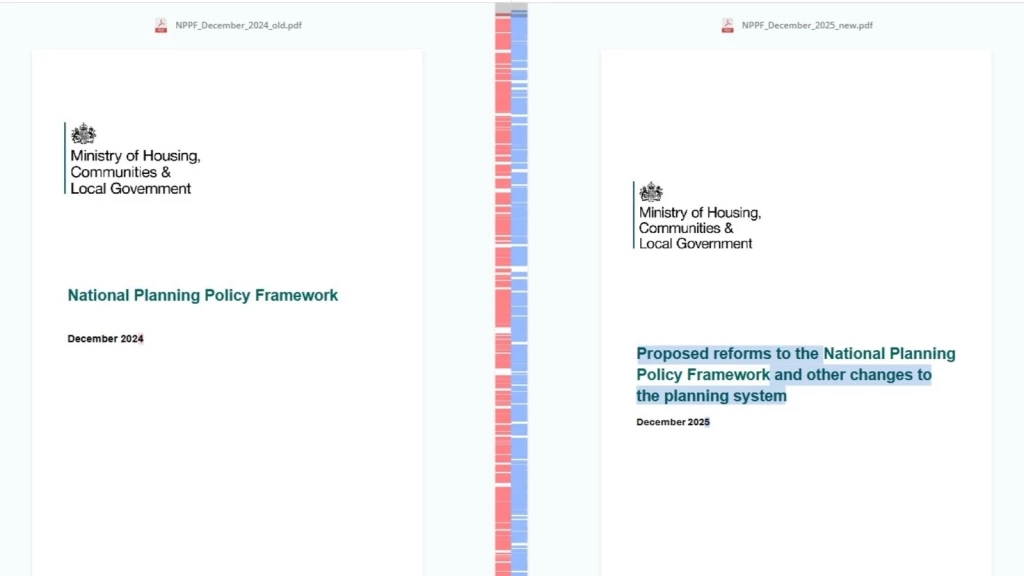
The final revised NPPF, expected in summer 2026, will be important because it will show whether the government can move from reform rhetoric to implementation clarity.
Developers, councils, landowners and communities need to know how the new rules fit together.
They need clarity on the presumption in favour of development, Grey Belt decision-making, station-adjacent development, local plan timetables, site thresholds, viability expectations, decision-making roles and design quality.
Policy uncertainty is itself a cost.
If the NPPF becomes clearer, it may help reduce arguments and speed up decision-making. If it creates new ambiguity, it may simply move disputes into a different part of the system.

Britain does not simply need more planning permissions. It needs a planning and delivery system that makes good development easier to approve, easier to fund, easier to build and easier for communities to understand.
The government is right to challenge delay, restore housing targets, reform statutory consultees and rethink Green Belt and Grey Belt policy. As we explored in Green Light to Green Belt Developments, not all Green Belt land performs the same function. Some sites protect openness and settlement separation. Others are poorly performing, sustainable and capable of delivering much-needed homes.
That matters acutely in London, where the housing shortage is severe and deliverable land is scarce. If we are serious about delivery, we cannot avoid difficult questions about underused land, low-performing Green Belt edges and even some golf courses where the public benefit of housing may outweigh private recreational use.
The London housing emergency package points in the right direction because it recognises that viability is central. A scheme that does not stack up will not be built, however strong the political ambition.
But planning reform cannot succeed if the wider delivery system remains too slow, too expensive and too fragmented. A permission is not a start on site. A funding announcement is not usable cashflow. A housing target is not a completed home.
The government also needs to be honest about the cumulative burden. Building safety reform, biodiversity net gain, environmental regulation, affordable housing obligations, infrastructure contributions and design standards all have legitimate purposes. But accumulated friction is still friction.
The answer is not deregulation for its own sake. It is proportionate regulation, earlier coordination and a planning culture that distinguishes genuine public interest from procedural drag.
A faster front door is not enough if developers, councils, housing associations and SME builders are left carrying a heavier backpack once they get inside. That is not delivery reform. It is a displacement of delay.

At Urbanist Architecture, we support landowners, developers and homeowners with complex planning opportunities, including Green Belt, Grey Belt, countryside and edge-of-settlement sites.
Through our comprehensive architectural services, we first carry out feasibility studies and assessments to explore whether a site has realistic development potential by looking beyond one headline figure. We consider the full picture: housing need, five-year housing land supply, Green Belt and Grey Belt policy, site constraints, local plan status, design potential and the realistic prospects of securing planning permission.
For larger or more sensitive sites, early viability input may also be important, particularly where affordable housing, infrastructure contributions, Golden Rules requirements or abnormal costs could affect deliverability. The strongest strategies bring planning, design, technical evidence and viability together from the outset, rather than treating them as separate issues later in the process.
If you own land in an authority under housing supply pressure, the first step is to understand whether the opportunity is real, and what evidence would be needed to make a credible case.
A carefully prepared planning strategy may reveal a route forward. A weak, rushed or generic case may simply expose the site to refusal. That is why evidence matters, and why the right planning advice can make all the difference.
We look forward to learning how we can help you. Simply fill in the form below and someone on our team will respond to you at the earliest opportunity.
The latest news, updates and expert views for ambitious, high-achieving and purpose-driven homeowners and property entrepreneurs.









We specialise in crafting creative design and planning strategies to unlock the hidden potential of developments, secure planning permission and deliver imaginative projects on tricky sites
Write us a message