Read next
The latest news, updates and expert views for ambitious, high-achieving and purpose-driven homeowners and property entrepreneurs.


The December 2024 National Planning Policy Framework marked a decisive moment in English planning policy. It reintroduced delivery discipline, clarified housing need, and began the long-overdue task of modernising Green Belt policy through the introduction of Grey Belt land. The ink had barely dried before the Government moved further.
On 16 December 2025, little more than a year after NPPF 2024 came into force, a consultation draft of a further revised framework was published, with the final version currently expected in summer 2026. The pace of reform is deliberate, not incidental.
The draft sharpens a distinction that has long been blurred in practice: the separation between plan-making and decision-making policies, with only the latter guiding how applications are assessed. The aim is to reduce uncertainty, limit local variation, and bring greater consistency to planning decisions nationwide.
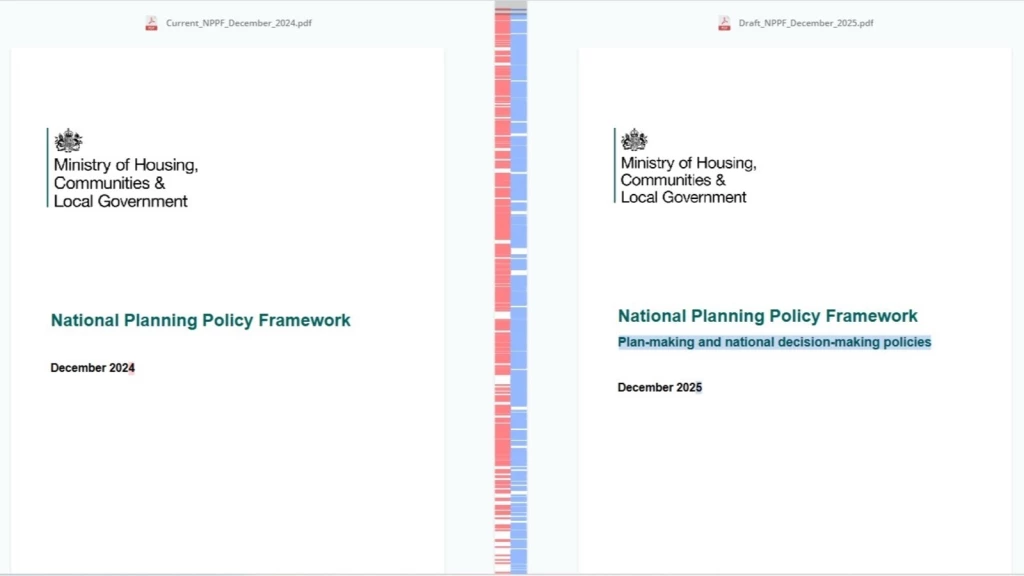
I have spent hours going through these documents line by line, comparing what has changed against what we deal with in practice every week, and have prepared a comparison document setting out the differences in detail.
However, if you want to skip straight to what matters, I have broken down the analysis into 15 sections, each cutting through the policy language to focus on what will genuinely shift how decisions are made.
Let's get started.
On 16 December 2025, the Ministry of Housing, Communities and Local Government (MHCLG) launched a consultation on what it calls the most significant rewrite of national planning policy in over a decade.
The deadline for responses was 11:45pm on 10 March 2026, and the final revised version of the draft NPPF 2025 is currently expected to be published in summer 2026.
The draft NPPF 2025 is the government's proposed update to the National Planning Policy Framework, the central document governing planning policy in England. Published for consultation in December 2025, it represents the most significant planning reform in over a decade.
The draft NPPF 2025 separates plan-making policies from decision-making policies for the first time, meaning local planning authorities will follow distinct guidance when preparing local plans and when determining planning applications. This structural change is designed to prevent councils from duplicating, modifying, or layering local policies on top of national standards in ways that have historically been used to resist development.
For applicants, this shift offers greater certainty: schemes that comply with national decision-making policies should expect a clearer path to consent, regardless of local red tape. For councils, the framework signals that delivery is now the measure of success, and that locally crafted barriers to growth will carry diminishing weight in the planning balance.
The draft framework alone does not tell the full story. The press release sets out the political framing. The written ministerial statement from Matthew Pennycook explains the rationale. The letter from Steve Reed to local authority leaders and metro mayors spells out expectations. Updates to Planning Practice Guidance, including on viability, round out the picture.
Read together, they leave no room for doubt. The government is not being subtle about its intentions. The overriding goal is to accelerate housebuilding and clear the obstacles that have stood in the way. Every document reinforces the same message: local plans must deliver, viability arguments will face greater scrutiny, and delay is no longer acceptable.
A 123-page consultation document with 225 questions tells you everything about the ambition here. This is not a tweak to the margins. It is a deliberate attempt to reset expectations across the entire planning system.
To understand why refusal has become harder, it is necessary to start with the structure of the framework itself. I will then set out how the two frameworks differ, what has genuinely changed, and why those changes matter in practice. Along the way, I will translate the technical changes into their practical consequences for applicants, architects, planning consultants and planning officers.
NPPF 2024 follows the established structure of a single integrated framework, where plan-making and decision-making policies sit together and are applied through policy weight, consistency, and the status of the development plan.
Draft NPPF 2025 introduces a more deliberate architecture. It separates plan-making policies from national decision-making policies and states clearly that plan-making policies should not be used when determining planning applications. This is designed to reduce uncertainty at decision stage, narrow local interpretive drift, and create a more consistent national approach to decision-making.
The contents reflect this shift: 17 chapters become 20, reorganised under five thematic headings that distinguish procedural, strategic, and environmental policies. The annexes expand from three to six, pulling technical guidance on housing calculations, information requirements, and Green Belt assessments into the framework itself.
Crucially, the draft establishes a strict hierarchy of weight. It explicitly states that where a policy in an adopted development plan conflicts with a National Decision-Making Policy, the local policy should be afforded very limited weight. In effect, national standards will now actively trump inconsistent local preferences, rendering many defensive local policies obsolete overnight.
Initial responses from the profession, however, suggest the choice of language here warrants scrutiny. Determining whether two policies conflict involves layered legal questions: what does each policy mean, and do they produce different outcomes?
Jurisprudence in this area remains unsettled, offering multiple interpretive approaches, each capable of generating litigation. If the test becomes a matter of subjective judgment rather than objective application, the predictability this mechanism seeks to establish may be compromised from the outset. Alternative formulations such as "materially different" or "inconsistent in substance" might deliver greater operational clarity.
Annex A, paragraph 2 puts the hierarchy into practice. It dictates that any local policy "inconsistent in any way" with the new national standards must be given very limited weight. This represents a far tighter threshold than previous iterations of the framework. As soon as the draft NPPF 2025 is finalised and published, which is currently expected in summer 2026, it will effectively diminish the authority of existing local plans that do not align.
For local authorities, the message is stark: the era of local exceptionalism is over. Linguistic nuances in local policy can no longer be deployed to circumvent national growth targets. The framework demands a laser-like focus on delivery, ensuring that national consistency prevails over historic tendencies toward parochial interpretation.
This is not a structural tidy-up. It is a shift in authority. The draft NPPF 2025 moves the system away from preference-led interpretation and towards clearer national outcomes. That will feel uncomfortable in places where discretion has been used as a shield against delivery, but predictability is precisely what the system has lacked.
As I noted in my interview with RIBA (Royal Institute of British Architects), the real significance of the draft lies not in any single policy amendment but in the way it seeks to re-engineer the decision-making environment itself.
The structural changes are not merely presentational. They are designed to narrow the scope for avoidance, reduce vulnerability to local obstruction, and place greater weight on delivery, evidence and design quality.
The direction is clear: fewer grey areas, stronger national direction, and decision-making anchored in outcomes rather than outdated policy positions. For applicants, success will depend on alignment, evidence and design quality. For authorities, refusal will increasingly require robust justification rather than reliance on risk aversion. If NPPF 2024 sharpened the tools, the draft seeks to change how they are used.
This is not the end of discretion. It is the beginning of accountability.
There is, however, an internal tension that practitioners should not overlook. Qualifying language runs throughout the document, with conditional exceptions appearing repeatedly across the policy text. Each one creates a potential departure from the standardised outcomes the framework appears to pursue.
A rules-based system derives its value from predictability, and excessive qualification weakens that predictability at source. The final version will need to reconcile its directive ambitions with the escape routes still embedded in its drafting.
With that caveat in mind, what does this mean when you turn to the policies themselves? It begins with the most consequential lever in the entire framework: the presumption in favour of sustainable development.

If there is one policy lever that determines whether schemes live or die, this is it.
Under NPPF 2024, the presumption in favour operates through planning balance. Development that accords with an up-to-date plan should be approved without delay. Where key policies are out of date, permission should be granted unless protected policies indicate otherwise or adverse impacts clearly outweigh the benefits.
The Draft 2025 Framework retains the presumption in favour of sustainable development but reframes it through a more location-led logic. Development within settlements and development outside settlements are treated distinctly, with clearer national expectations about where growth should occur.
The draft shifts the debate away from abstract planning merit and towards a clearer threshold question: is this development in a place where the system expects growth?
Furthermore, the language governing the 'tilted balance' has been tightened. Under the new text, permission should be granted unless adverse impacts "substantially outweigh" the benefits. This is a change from the previous "significantly and demonstrably" test. This subtle rephrasing suggests a higher quantitative bar for refusal, implying that harms must be of considerable scale or importance to override the default "yes."
Nowhere is that shift more visible than at the edge of settlements.
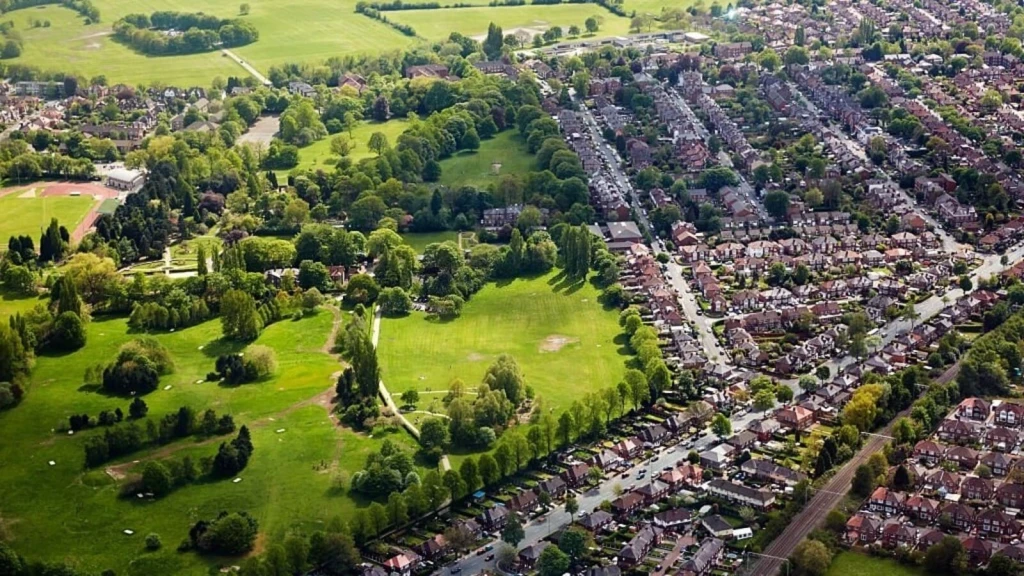
For many years, greenfield sites at the edge of settlements have been caught in policy deadlock. Where settlement boundaries are out of date and housing delivery is failing, such sites are routinely refused in principle, even when they sit adjacent to existing development, are well connected to services, and are capable of forming logical extensions to settlements.
The direction of travel in the draft NPPF 2025 points towards a different approach. Where a local planning authority cannot demonstrate a five-year housing land supply, the presumption in favour of sustainable development is expected to engage earlier and more decisively. In those circumstances, rigid settlement boundaries are no longer treated as absolute barriers but as policy tools whose weight depends on whether the plan is delivering.
This represents a significant practical shift. The key question becomes whether the site is suitably located and whether its impacts can be addressed, rather than whether development crosses an outdated line on a plan. For edge-of-settlement greenfield sites, decision-making moves away from prolonged debate about principle and towards tangible considerations such as accessibility, infrastructure capacity, landscape impact, and deliverability.
Where delivery is failing and impacts can be managed, planning permission should not be withheld simply because a boundary has not yet caught up with reality.
Early industry response suggests this restructuring carries significant implications for how housing appeals are prepared. Under the current framework, practitioners must conduct detailed assessments of each relevant policy, determine whether individual policies are out of date, and reach conclusions about whether the aggregate policy position triggers the tilted balance — an exercise that has become the bane of many a proof of evidence.
The draft largely dispenses with this layered analysis in favour of a cleaner binary distinction: sites within settlements benefit from the robust S4 presumption, while those outside must demonstrate need under S5. This simplification should streamline evidence and reduce procedural arguments at inquiry, allowing hearings to focus on substantive planning merits rather than policy mechanics.
The presumption is becoming operational rather than philosophical. In the right locations, refusal will increasingly need to be justified by evidence of harm, not by policy inertia. Once the presumption engages earlier, the next question becomes unavoidable: how much housing is actually required.
This is where the draft NPPF 2025 becomes technically unforgiving.
The 2024 Framework anchors housing need in the standard method and reinforces the expectation that plans should meet identified needs and respond to demographic realities.
Here is the critical change: The Draft 2025 Framework retains this foundation but strengthens the strategic logic behind requirement-setting. It reduces the scope for housing numbers to be treated as a negotiable political outcome rather than a reflection of need.
Crucially, the calculation itself has changed. The new method abandons the volatility of household projections in favour of a baseline set at 0.8% of existing housing stock, providing a more stable, supply-oriented target. Furthermore, the arbitrary 35% urban uplift for the largest cities has been scrapped in favour of a universal affordability adjustment that kicks in earlier (at a ratio of 5 rather than 4) and bites harder.
The scale of the problem justifies this shift. Centre for Cities estimates that compared to the average European country, Britain has a backlog of 4.3 million homes that were never built. To clear this deficit within 25 years while meeting ongoing demand would require 442,000 homes per year in England alone. At current delivery rates, the backlog would take over half a century to address. The government's 300,000 target, even if achieved, does not close the gap.
The UK faces a 4.3 million home deficit. One in four people will be over 65 by 2050, yet we deliver 7,000 retirement homes annually against a need of 30,000 to 50,000. Nearly all net household growth has been driven by immigration. Affordability suppresses household formation by pricing out the young. These are not projections to be debated. They are conditions to be addressed.
The draft NPPF 2025 responds correctly. By tethering need to existing stock, it removes the "shrinking population" defence used by authorities to suppress targets. It hardens housing numbers against political dilution and redirects debate from whether growth should occur to where and how. Housing numbers only matter if they survive political cycles. The draft gives them a better chance.
But setting the number is one thing. Delivering it is another. Demand forecasting must be recalibrated, and the mix matters as much as the number. The current pipeline is misaligned with actual need at almost every level. The gaps are visible across every tenure.
Retirement housing is an afterthought despite an ageing population. Affordable homes for key workers and first-time buyers remain critically short. Family housing in sustainable locations loses out to viability-driven flatted schemes. The private rented sector now absorbs demand that ownership once met, yet build-to-rent remains a city centre product.
None of this can be solved through new build alone. With 38% of our stock built before 1946 and four out of five 2050 households already housed, regeneration, retrofit and adaptation are no longer peripheral. They are core strategy.

This is where policy stops being theoretical and starts to bite.
NPPF 2024 relies on established delivery mechanisms, including five-year housing land supply requirements, buffers, and Housing Delivery Test consequences. Where delivery falls materially below requirement, the tilted balance applies. Most significantly, the draft NPPF 2025 reinstates the five-year housing land supply requirement for all authorities, removing the recent four-year supply arrangement and the protection previously afforded to authorities with recently adopted plans or advanced stages of plan-making.
This is reinforced by the new Policy HO7, which explicitly directs decision-makers to give "substantial weight" to the benefits of providing homes that meet evidenced needs. This removes the discretion to downplay the benefits of supply in the planning balance, particularly where an authority is failing the Housing Delivery Test.
However, the draft also introduces a new tactical incentive: where a scheme exceeds the affordable housing requirement, local authorities are instructed to take a flexible approach to the size and mix requirements for the market housing component.
Furthermore, the draft explicitly allows for off-site affordable housing provision where it would optimise the quantity and quality of homes, codifying a flexibility that was previously often resisted. In plain terms, over-delivering affordable housing may now buy you flexibility elsewhere, and that changes how schemes should be structured from day one.
The real change is not mechanical but psychological. Where delivery has collapsed, where five-year land supply has evaporated or housing delivery test scores have slumped below 75%, decision-makers will increasingly shelter behind national policy rather than exercise local discretion. For applicants, this creates a starker sorting mechanism: strong schemes in sustainable locations should move to consent more quickly; weak schemes should fail more decisively.
The space for negotiation contracts in one sense but deepens in another. Affordable housing, long treated by developers as a viability hurdle to be negotiated down, becomes instead a lever for unlocking the presumption in favour of development. Those who grasp this inversion will prosper; those who do not will find planning committees and inspectors less sympathetic than before. And if this logic reshapes decision-making in urban areas, its effects on Green Belt policy are more profound still.

This is the most politically charged part of the draft NPPF 2025, and the most misunderstood.
The introduction of Grey Belt in NPPF 2024 marked a fundamental shift in Green Belt policy. It acknowledged that some Green Belt land performs poorly against purposes (a), (b) and (d), namely checking sprawl, preventing merger of towns, and preserving the setting of historic towns, and created a route through which development on such land may not be treated as inappropriate, provided strict tests are met. The Golden Rules introduced discipline by requiring tangible public benefits in return for release.
The draft framework retains this architecture but systematises it. The refinement does not weaken Green Belt protection indiscriminately. What it does is apply the same shift in decision-making logic seen elsewhere in the draft, with an additional layer of policy discipline specific to Green Belt.
This is the point most observers miss.
The definition of Grey Belt has been calibrated to be permissive. It excludes land that strongly contributes to Green Belt purposes, but notably omits the purpose of "safeguarding the countryside from encroachment." This subtle exclusion significantly widens the net for potential sites. For schemes that pass the Grey Belt assessment and satisfy the Golden Rules, the usual presumption against inappropriate development falls away.
By excluding “safeguarding the countryside from encroachment” from the Grey Belt test, the government acknowledges that land can be rural in character without “strongly contributing” to the Green Belt’s strategic function. If a site doesn’t strongly serve to check sprawl or prevent town merger, it qualifies as Grey Belt even if it is currently undeveloped greenfield.
Once classified as Grey Belt and compliant with the Golden Rules, development is no longer deemed “inappropriate.” This shifts the legal hurdle away from demonstrating very special circumstances toward a straightforward test of policy compliance. This is the difference between arguing principle and arguing compliance, and it changes the tone of committees and appeals entirely.
A separate pathway emerges for transport-led growth. The draft introduces a specific Green Belt exception for development in sustainable locations around railway stations. This offers a route to Green Belt planning permission that does not depend on Grey Belt classification or cross-boundary cooperation, but simply on the logic of concentrating homes where public transport capacity already exists.
Taken together, these changes reinforce a principle: Green Belt policy should be applied with analytical rigour rather than blanket restraint. Where land performs weakly against key purposes and occupies a sustainable location, the policy emphasis moves from automatic classification as inappropriate development towards a structured assessment of harm, mitigation, and public benefit. The Golden Rules act as the necessary counterbalance, ensuring that release delivers tangible gains rather than incremental erosion.
This reframes Green Belt decision-making from a defensive exercise into a managed and accountable process. The question is no longer whether change should happen, but whether change is directed to the least harmful land and delivers outcomes that serve the wider public interest.
Beyond the headlines, there is a quiet revolution for existing brownfield sites within the Green Belt. Under the new text, redevelopment of previously developed land is now "not inappropriate" provided it does not cause "substantial harm" to openness. This is a distinct linguistic shift from the previous "no greater impact" test. It effectively permits intensification and height increases on sites that were previously frozen in their current form by rigid openness constraints. For owners of underutilised Green Belt brownfield, this is a significant opportunity.
Grey Belt is not about building anywhere. It is about directing growth to the least harmful land and being honest about where the Green Belt no longer performs the role it was designated to play. It was the central thesis of Green Light to Green Belt Developments, which I co-authored with Nicole Guler MRTPI, one of the directors at Urbanist Architecture.
We examined the gap between the policy's stated purposes and the reality on the ground: golf courses, scrubland, distribution depots and private farmland mistakenly treated as sacrosanct countryside. After years of working on Green Belt and edge-of-settlement sites, one lesson stands out: pretending all Green Belt land is equal undermines public trust and weakens the policy itself.
The shift from "inappropriate" to "not inappropriate" development is significant. It moves the debate away from abstract principle and into a more disciplined conversation about impacts, mitigation, and public benefit. That is a healthier foundation for decision-making, particularly when housing delivery is failing and sustainable locations remain artificially constrained.
The change for existing brownfield sites within the Green Belt matters just as much. Allowing intensification where there is no substantial harm to openness reflects how places actually evolve and avoids freezing compromised sites in inefficient forms. But this flexibility comes with conditions. The Golden Rules are the price of responsible release, and they must be applied rigorously.
To ensure this, the draft NPPF 2025 restricts the use of site-specific viability assessments to three specific scenarios: where the site comprises previously developed land, where it is a large multi-phase strategic site, or where the development model is wholly different to that assumed in the plan. Outside of these exceptions, the expected contributions for affordable housing and infrastructure are intended to be non-negotiable.
These reforms will only succeed if they are embedded in plans that are honest about delivery and applied consistently at decision stage. If Grey Belt becomes a shortcut, it will fail. If it is treated as a structured, evidence-led pathway with clear public benefit, it has the potential to strengthen Green Belt policy rather than erode it.

This is where many authorities will feel the pressure first.
NPPF 2024 reaffirmed the plan-led system but left the lived reality of plan-making largely unchanged. In practice, many authorities continued to operate with plans that were out of date, overly defensive or slow to progress through examination. Where delivery failure persisted, the system often defaulted to appeals and tilted balance arguments to plug the gap, which is neither efficient nor coherent.
The draft NPPF 2025 responds by tightening the transitional rules and removing the incentive to game the system. If an authority submits a plan under the old framework but it delivers less than 80% of the new housing need figure, the transitional arrangements require the authority to begin a new plan immediately upon adoption. In other words, rushing a “defensive” plan through no longer buys five years of lower numbers; it triggers an instant reset. The effect is to close a long-standing loophole and push authorities away from procedural delay and towards objective delivery.
More broadly, the draft treats plan-making as the central delivery mechanism rather than a procedural formality. It distinguishes clearly between plan-making policies and national decision-making policies, implying a more disciplined division of labour and a clearer hierarchy. Where a Spatial Development Strategy (SDS), such as those prepared by Combined Authorities, is in place, it sets the housing requirement. The draft is explicit that these numbers should not be re-litigated at Local Plan stage.
Local plans are then expected to focus on genuinely local decisions: spatial strategy, site allocations, infrastructure alignment, locally specific design expectations and policy choices that respond to real constraints. National decision-making policies, by contrast, are positioned to cover generic development management matters, reducing the incentive for local plans to duplicate national content and limiting the scope for policy layering that slows decision-making.
The draft also signals a more strategic and less parochial approach to distributing growth. Plan-making under this direction is not simply about protecting what exists, but about shaping where growth should go, including around transport nodes, within and adjoining settlements and in locations that support sustainable patterns of development. The expectation that plans remain aligned with delivery outcomes is more explicit, not least because the draft reduces the policy comfort available to authorities whose plans are failing.
A less visible but highly important implication is the likely shift in examination dynamics. If national decision policies carry greater weight, local plan policies that are inconsistent, overly restrictive or poorly evidenced become harder to defend at examination and easier to sideline at decision stage. That incentivises councils to align policies properly, evidence constraints robustly and allocate land more realistically rather than defensively.
The plan-led system only works when plans are current, deliverable, and honest about where growth must go. The draft points towards a world where a plan that avoids difficult decisions loses authority in practice. That should be uncomfortable. It is also necessary.
This shifts the battlefield. Developers and objectors accustomed to fighting housing numbers at local plan inquiries may find the door already bolted. The debate on "how many homes" is moving up to the strategic level; the local plan will simply be about "where," not "if."
Growth is no longer treated as a background benefit. It is an explicit objective.
NPPF 2024 positions economic development as an essential component of sustainable development, while largely retaining the established framework for safeguarding employment land, supporting business growth and enabling modern sectors.
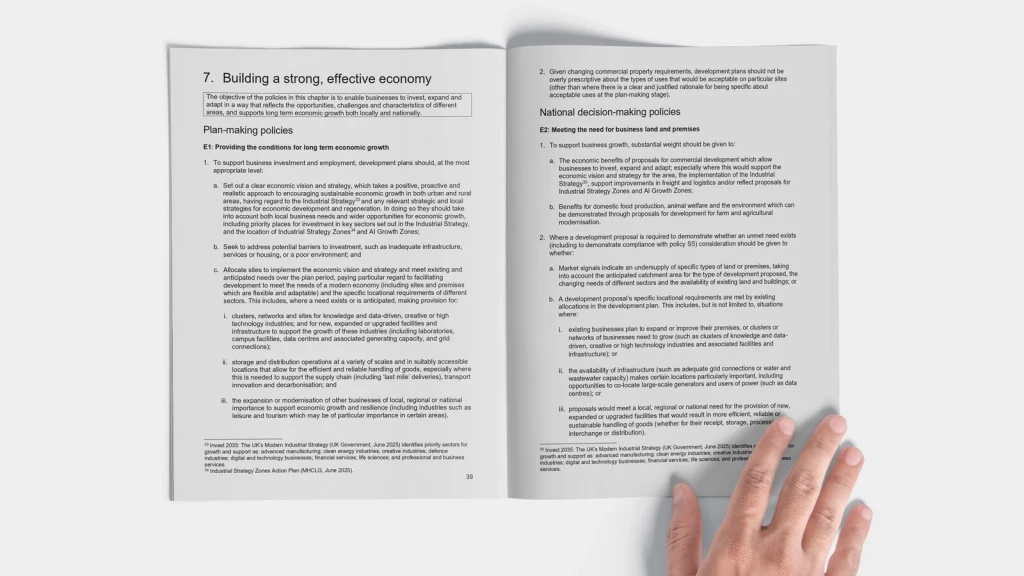
The draft NPPF 2025 pushes economic growth closer to the centre of national policy and signals a stronger intent to remove friction where development is appropriate. This is not simply a general pro-development tilt. It is also sector-specific. The draft explicitly champions the infrastructure of the modern economy, including data centres, laboratories, gigafactories and logistics, and indicates that their delivery should carry substantial weight.
This pivot is cemented in Policy E2, which upgrades the weight afforded to economic benefits from “significant” to “substantial”. More importantly, it requires that this weight is applied to proposals addressing an unmet need, even where the site sits outside current settlement boundaries. By tethering decisions to “market signals”, the draft also sidesteps a familiar bottleneck: employment land reviews that are often out of date and slow to reflect changing demand. However, a new hurdle appears in Policy E3.1B, which introduces specific amenity considerations for freight and logistics. This may provide a fresh avenue for local opposition and could blunt the very pro-growth edge the Government is trying to sharpen.
Building on this, the draft introduces a clearer market-signal trigger. Where there is robust evidence of high demand for logistics or commercial space, that demand may justify development beyond settlement boundaries even where land has not been allocated.
In practical terms, the draft’s more rules-based decision environment is likely to reduce the scope for refusals built on vague economic concerns, duplicative local policy wording or speculative assertions about demand. Where proposals demonstrate need, compatibility and deliverability, the planning system is expected to respond with greater clarity and speed.
Growth is not the enemy of place-making. Poor growth is. The draft for NPPF 2025 reflects a belated recognition that a modern economy requires modern spatial planning, and that job creation and housing delivery are not competing objectives but mutually reinforcing ones.
By explicitly naming data centres, laboratories and logistics, the government is treating the physical infrastructure of the digital economy as it treats energy or transport: as nationally significant. Planning committees have long regarded these facilities as oversised sheds to be hidden at the edge of settlements. That instinct now runs counter to national policy.
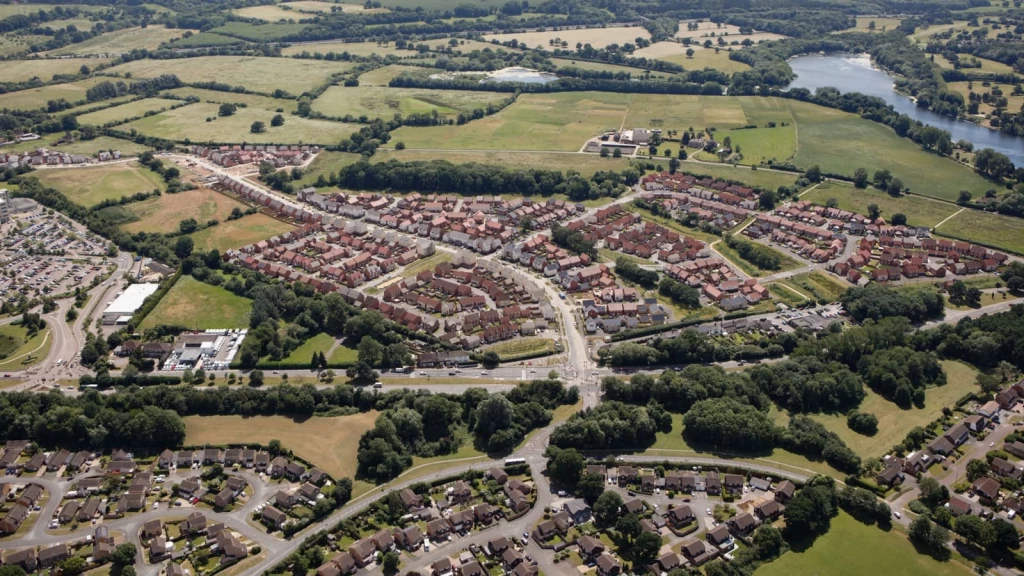
NPPF 2024 positions sustainable transport as a core planning objective and expects development to reduce reliance on private cars through location, layout and connectivity. However, it does not provide a clear national mechanism that consistently changes outcomes for station-led development in the way the draft NPPF 2025 now proposes.
The draft is more explicit. It elevates stations as anchors for growth and signals that planning decisions should treat these locations as policy priority areas. Crucially, this is not framed as a broad aspiration; it is set up as a definable status.
To qualify as “well-connected” outside existing settlements, a station must generally serve a high-productivity area, specifically one of the top 60 Travel to Work Areas by Gross Value Added, and meet strict service frequency tests, typically requiring four departures an hour or a consistent daytime service. Where these criteria are met, the presumption in favour of sustainable development is effectively switched on permanently, provided the scheme meets a minimum medium density of 50 dwellings per hectare.
This matters because it provides a clearer national rationale for concentrating density where public transport capacity exists and where services may be supported. It also shifts the planning conversation away from whether intensification is acceptable and towards how intensification may be delivered well. The scale of land this could theoretically bring into play is immense.
This shift aligns with the draft’s broader move away from “predict and provide” transport modelling toward a “vision-led” approach. Transport assessments are no longer just about counting cars and junction capacity; they are expected to support the vision of the development, prioritising active travel and public transport over theoretical “worst-case” assumptions of car dominance.
This policy direction is likely to change the shape of arguments at committee and appeal. It becomes harder to resist station-led schemes solely because they represent change, particularly where housing delivery is failing and where impacts can be mitigated.
At Urbanist Architecture, we've long advocated for station-led development, not as a density exercise, but as place-making rooted in infrastructure reality. Locating growth around transport nodes is one of the few strategies that genuinely delivers on multiple fronts: housing supply, reduced car dependency, and viable local services. Done well, it represents some of the most sustainable development the planning system can enable.
But success hinges on robust urban design and master planning strategies. Density needs structure: clear street hierarchies, active ground floors, legible movement, and well-defined public space. Height and massing should respond to context rather than flatten it. Increased intensity must be offset by generous daylight, usable amenity, and coherent townscape.
Station-led density works when it feels intentional. When applicants treat transport proximity as licence to maximise floor area without design logic, resistance follows. But where schemes demonstrate that intensity strengthens walkability, animates streets, and reinforces local centres, the planning argument becomes far stronger.
The draft’s direction is right. The challenge now is ensuring implementation keeps pace with ambition. One concern is that the methodology leans on 2011 Census evidence, which is now fifteen years out of date and does not reflect post-pandemic travel patterns. If the policy is intended to hardwire outcomes nationally, the evidence base and metrics need to be equally future-facing.
There is also a structural weakness in the threshold criteria: what Lichfields has termed the “frequency trap”. By limiting the policy to stations that already have high service levels, the draft excludes large areas of sustainable land around countryside or edge-of-settlement stations that currently see fewer trains precisely because they lack housing.
According to Lichfields' analysis, if the criteria were widened to include the top 80 Travel to Work Areas by productivity and stations with just one train per hour in each direction, the development capacity could rise from around 630,000 homes to nearly 1.5 million. The current policy risks leaving perfectly viable locations stuck in a vicious circle: unable to grow because the trains do not stop often enough, and unable to secure better services because the growth is not permitted. This is a solvable problem, and one the Government should revisit before the new framework is finalised.
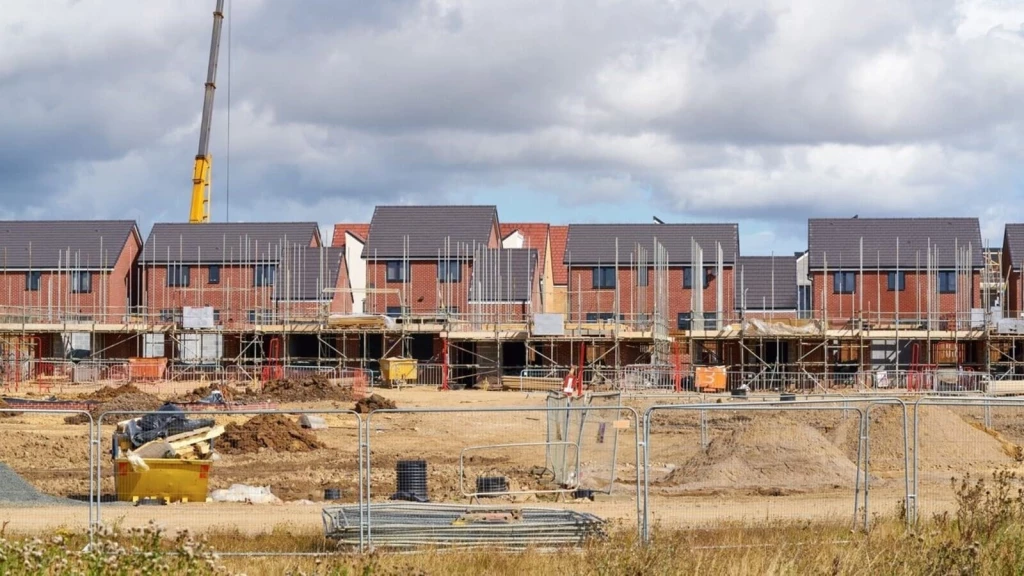
NPPF 2024 retains the primacy of the development plan and treats national policy as a material consideration applied through established weight principles. That framework creates flexibility, but it also creates inconsistency. In practice, the same scheme can attract very different outcomes depending on local political culture, committee risk appetite, and the way local policies are interpreted.
The Draft 2025 direction elevates national decision-making policies and reduces the influence of local policies that conflict with national objectives. The intention is not to remove localism entirely, but to reduce the use of local policy as a mechanism for avoiding delivery when the wider system is failing.
Crucially, this discipline extends to the internal machinery of decision-making, and the reforms take aim at every stage of the process.
The first target is validation. By proposing standardised national validation requirements, the draft seeks to end the practice of local planning authorities using excessive local validation lists as a tool to delay the clock starting on an application. Under the proposed changes, authorities would only be able to demand additional information where a specific development plan policy expressly requires a particular study or assessment.
Practitioners responding to the draft have welcomed this specificity. Arbitrary local requirements, such as insisting on specific file formats or imposing checklists untethered to policy, would no longer have standing. For those submitting applications, this should accelerate validation and bring forward the start of determination periods. For local authorities, it removes a layer of administrative discretion that has occasionally functioned as a gatekeeping mechanism rather than a quality control.
The second target is the handling of consultations. The draft introduces a requirement that decisions should not be delayed to secure advice from statutory or internal consultees beyond their deadlines, unless that advice is critical to the decision or could enable an approval. This is a direct challenge to the holding objection culture, where determinations drift indefinitely while waiting for internal comments.
Architects and planning consultants know this pattern all too well: applications left in limbo for months awaiting a highways response, an ecology comment, or a drainage sign-off that never materialises. The holding objection has become a reflex, not a reasoned position.
Together, these changes are likely to affect how officers write reports, how committees frame refusals, and how inspectors assess appeals. Local decision-making becomes more accountable to national objectives, and refusal becomes harder to defend where it relies on policies that are out of date or unsupported by evidence.
Localism is not the same as inconsistency. A planning system that produces different outcomes for identical proposals undermines trust in the process itself. National clarity should narrow that gap and restore a baseline of fairness across the country.
The message to local authorities is clear: if your internal teams do not respond in time, you must proceed without them. The silence of statutory consultees has functioned as a pocket veto for years, and this policy shift attempts to break that deadlock.
A final warning is buried in the enforcement provisions. Intentional unauthorised development will now carry "substantial weight" against the grant of planning permission. This codifies what was previously a written ministerial statement into hard policy, significantly increasing the risk for those who build first and seek forgiveness later. The days of treating retrospective consent as a neutral fallback may be numbered.
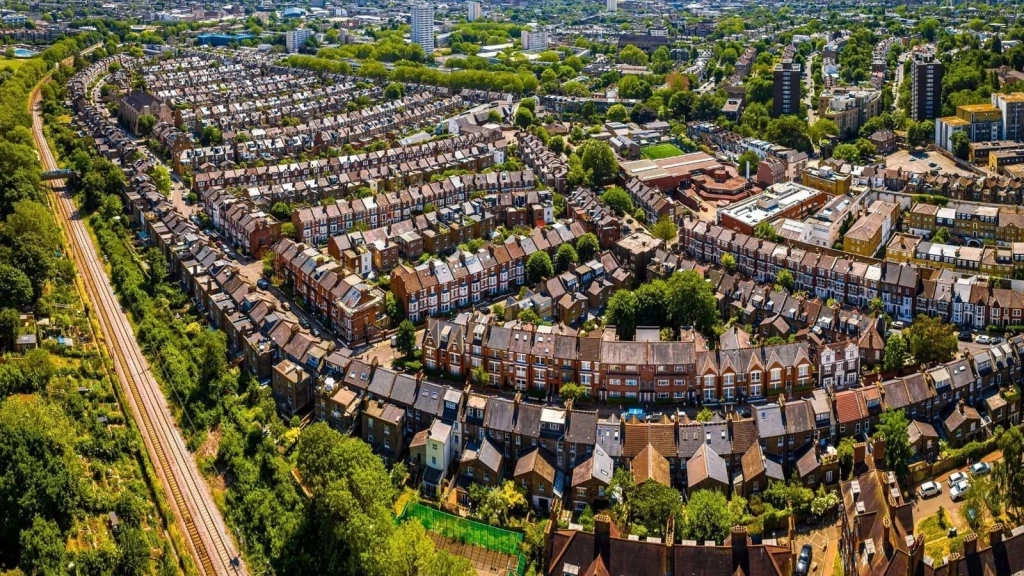
NPPF 2024 places strong emphasis on good design, effective use of land, and high-quality place-making, while leaving density decisions to local context, design coding, and policy interpretation.
The Draft 2025 direction places greater pressure on under-optimised land, especially in sustainable locations. It implies that a low-density outcome in a highly accessible area is not automatically defensible simply because it feels familiar or comfortable.
This does not mean the draft mandates poor design. It means the system becomes less tolerant of land being used inefficiently where housing delivery is failing and where accessibility supports more intensive development.
The language is becoming punitive regarding inefficiency. The draft states that development proposals which do not make efficient use of land, particularly in sustainable locations, should be refused. This moves density from an "aspiration" to a condition of consent.
This policy direction enters a contested space. Globally, the density and affordability debate remains unresolved. Sprawl advocates cite Houston's affordability; densification advocates cite Auckland's upzoning success. Neither model applies to London, where Green Belt constraints and the lowest housing stock per capita in Europe create a unique condition.
What I observe in London's suburbs contradicts both narratives. A £1 million house is replaced by three units at £1.2 to £1.4 million each. The value uplift benefits landowners and developers, not future residents. This is density monetising scarcity, not solving affordability.
The draft NPPF correctly identifies under-development in sustainable locations as a problem. But density without design rigour simply creates new failures. The policy asks the right question. The answer must come through schemes that earn their intensity through considered massing, protected daylight, and coherent townscape.
This is where design codes and local character evidence should do real work, not provide a pretext for refusal. If the system is going to demand efficient land use, it must also reward applicants who show, in drawings and in evidence, that intensity can improve a place rather than overwhelm it.

A clearer national policy environment should reduce speculative refusals and narrow the grounds on which appeals are won and lost. Under NPPF 2024, appeals were often the arena where supply failures were tested and corrected, but with mixed predictability. With the Draft NPPF 2025’s more directive national policies, the appeal landscape is already evolving.
One of the most instructive developments has been how Grey Belt appeals have played out in practice. Early data shows that a large majority of major residential appeals on Grey Belt land are being allowed because the policy removes the need to demonstrate very special circumstances when the criteria are met, shifting the focus onto sustainable location, compliance with the Golden Rules, and demonstrable housing need.
In fact, recent appeal analyses show that around four in five major residential Grey Belt appeals have been approved by the Planning Inspectorate since the updated policy took effect, with overall approval rates meaningfully higher than under the old Green Belt regime. At the same time, not all Grey Belt appeals succeed; decisions still turn on context, sustainability, and the strength of evidence on both harm and deliverability.
In practice, this means that appeals will increasingly reward applicants who submit disciplined, policy-aligned cases with robust evidence of sustainable location, housing need, and compliance with the policy tests. Refusals that lean on outdated local policy or subjective concerns are likely to struggle because they will be measured against much clearer national criteria.
Until plan-making catches up with delivery imperatives, clearer appeal outcomes may be a necessary corrective to local inertia, but they will also require applicants to be more thoughtful, evidence-led, and pragmatic in both preparation and presentation.
A clearer national policy environment should reduce speculative refusals and narrow appeal uncertainty. But policy clarity alone will not fix the system. In my experience, many planning officers remain hesitant to approve schemes, not because they lack merit, but because officers fear being overruled or criticised for saying yes. It is easier, and safer, to refuse and let an inspector take the decision.
This risk aversion is compounded by a knowledge gap: too many officers are still applying outdated policy interpretations, unaware of or uncomfortable with the direction set by NPPF 2024, let alone the draft 2025 framework. The system should not rely on appeals to correct local failures, but until councils equip their teams to apply current policy with confidence, appeals will remain a necessary corrective to institutional caution.
NPPF 2024 aligns planning policy with net zero ambitions and climate resilience and expects both plans and decisions to address mitigation and adaptation. This is where the draft quietly changes the risk profile of sites.
The draft maintains this commitment, but its restructured approach makes policy application clearer between plan-making and decision-taking. That matters because climate policy often fails in practice not because it is absent, but because it is treated as a statement of principle rather than as a set of operational requirements that shape design, energy strategy, materials, overheating risk, water management, and biodiversity. Where benefits are clear and evidenced, approval becomes easier to justify.
A specific but high-impact change concerns surface water flooding. The draft removes the requirement for a sequential test on sites at risk of surface water flooding, provided the development can be made safe for its lifetime without increasing risk elsewhere. This unlocks a significant number of constrained urban sites that were previously trapped by rigid sequential logic despite being technically deliverable.
Equally significant is what has been removed. The concept of "valued landscapes," a subjective designation often used to block development on ordinary countryside that lacks national protection, appears to have been deleted from the framework. This strips away a nebulous layer of protection that often functioned as a proxy for Green Belt policy in areas where no Green Belt existed.
These removals are balanced by strengthened support for renewable energy. The benefits of renewable and low-carbon energy generation are upgraded from carrying "significant weight" to "substantial weight" in the planning balance.
However, the draft also introduces a new category of technical risk that is easy to underestimate until it derails a layout. A note of caution is warranted on the natural environment, where small definitional changes may have outsized operational consequences. The draft significantly expands the definition of “veteran trees”. Legal experts warn this broadens the scope for what constitutes a showstopper constraint, potentially bringing thousands of additional trees into a protection category that requires “wholly exceptional circumstances” to justify loss.
The technical catalyst for this risk is a seismic shift in the glossary definition of a “veteran tree”. By replacing a single “and” with an “or”, a tree no longer needs to meet criteria for age, size and condition, just one will do. This could overnight turn thousands of ordinary specimens into “showstopper” constraints requiring “wholly exceptional circumstances” to remove.
For developers, this is not just an environmental footnote; it is an operational requirement. It necessitates much earlier arboricultural assessments to avoid late-stage refusals or expensive redesigns. It highlights a recurring theme in the draft: while the front door for development is opening wider, technical caveats in the back room are becoming far more potent.
Environmental compliance must be designed in, not written in. Strong climate credentials can reduce objections, increase scheme legitimacy, and align development with long-term public interest.
The expanded definition of veteran trees reinforces why early and thorough site assessment is no longer optional. Schemes that treat ecological and arboricultural constraints as afterthoughts risk late-stage redesigns or outright refusal.
The shift to "substantial weight" for renewable energy is not just semantic; it is a signal to the Planning Inspectorate. It effectively tells Inspectors that the default answer for renewable infrastructure should be "yes," unless the local harms are overwhelming. For architects and planning consultants, the lesson is clear: quantify your climate benefits and present them prominently in the planning balance.
However, a new friction point has been introduced for greenfield sites. A sequential test for Best and Most Versatile (BMV) agricultural land is now explicitly required for significant development, adding a procedural hurdle that was previously confined to plan-making.
This will create tension for schemes on the urban fringe where BMV land is common, and applicants will need to demonstrate that alternative sites have been properly considered. For some edge-of-settlement schemes, this could prove as challenging as Green Belt.

NPPF 2024 requires planning to address the needs of different groups and to ensure the housing mix responds to local demand, including older people and disabled people.
The Draft 2025 direction signals clearer national expectations around accessibility and demographic alignment. This implies that accessibility standards and inclusive design will carry more weight, particularly in locations where demographic change is pushing demand towards adaptable and accessible homes.
In practice, schemes that demonstrate inclusive design, step-free access, and long-term adaptability should face fewer objections and stronger policy support, particularly where the local plan has been weak on delivery for these groups.
Over the years, working across everything from tight urban infill to larger housing schemes, I have seen how often accessibility gets treated as a technical afterthought. That is a mistake. A planning system that delivers homes people cannot use comfortably over their lifetimes is failing at a basic level.
The draft’s direction is right to treat accessibility as a mainstream expectation, not a specialist add-on. Demographic change is already shaping demand, and homes that are adaptable and inclusive tend to age better, serve communities better, and create fewer problems later. In practice, schemes that embed accessibility early are easier to justify, easier to deliver, and more defensible in the long term.
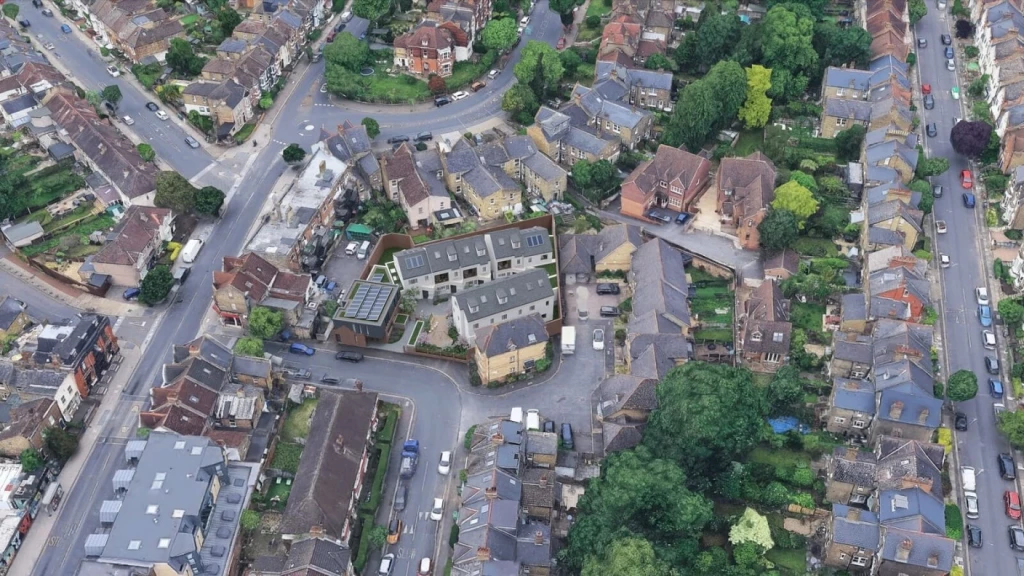
NPPF 2024 supports diversification of supply and recognises the role of small sites in maintaining delivery. In practice, however, delivery strategies remain overly dependent on large strategic allocations that take years to mobilise and are vulnerable to market cycles, infrastructure delays, and single-point-of-failure risk.
The Draft 2025 direction addresses this by formalising a supply category that has long existed in practice but lacked policy recognition: the medium site. Defined as schemes of 10 to 49 homes or up to 2.5 hectares, these sites occupy the space between garden-land infill and strategic allocation. They are large enough to make a meaningful contribution to supply, but small enough to be delivered quickly by regional housebuilders without complex phasing or extensive infrastructure.
To operationalise this, Policy HO6 proposes a dual quota. Authorities would be required to allocate land to accommodate at least 10 per cent of their housing requirement on small sites of no larger than one hectare, and a further 10 per cent on medium sites of between one and 2.5 hectares. This institutionalises supply diversity rather than leaving it to chance.
Supporting measures follow. Small sites under 0.2 hectares would be exempt from Biodiversity Net Gain requirements, and the consultation invites views on extending exemptions or simplified metrics to brownfield sites up to 2.5 hectares. A system that values delivery should treat medium sites as a strategic supply layer rather than a peripheral category. That requires clearer policy support, faster decision-making, and a proportionate approach to technical requirements.
There is, however, a notable gap. Explicit support for the subdivision of existing plots and residential intensification has been weakened in the draft. This is a missed opportunity. Subdivision has historically been a reliable engine for small builders to deliver hidden supply in sustainable locations without requiring new land allocations, and its quiet removal from the policy emphasis deserves scrutiny.
Resilience comes from diversification. After years of seeing delivery programmes slip because a single strategic site stalled, I have become wary of housing strategies that rely on a handful of mega-sites. When one piece fails, the whole pipeline suffers.
Small and medium sites provide a steadier rhythm of delivery, and they often fit more naturally within existing settlement patterns. They can stabilise supply, support SME builders, and reduce the systemic risk that comes with over-concentration. The draft’s thresholds and allocation requirements recognise that reality. They are a clear attempt to make small and medium sites unavoidable, not optional, and to stop them being dismissed as administratively inconvenient.
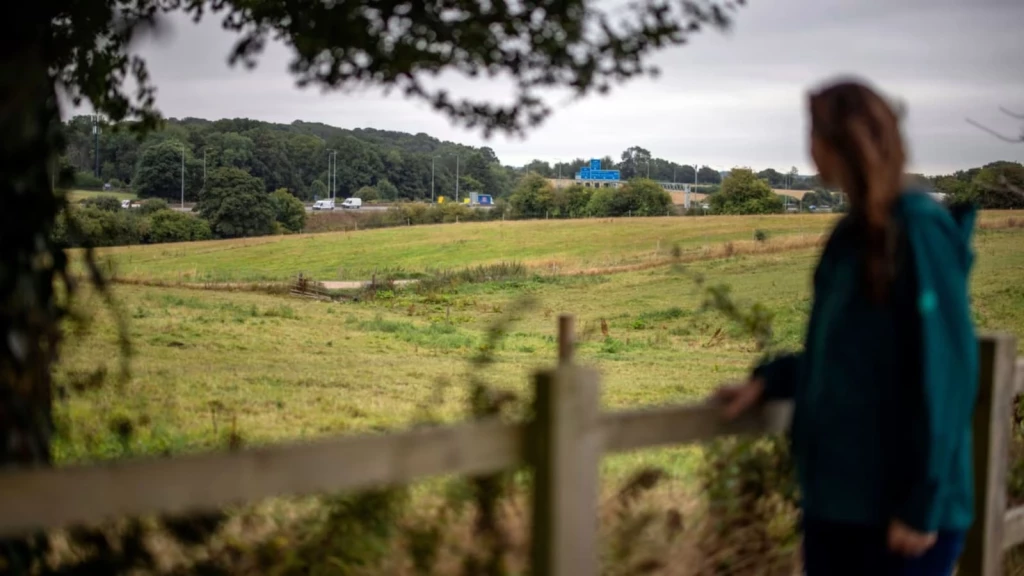
NPPF 2024 introduced the Golden Rules as a disciplined framework for public benefit where Green Belt land is released or where Grey Belt pathways are used.
The Draft 2025 consultation explores limited flexibility on viability while seeking to maintain minimum public benefit outcomes. This is a difficult balance. Too much flexibility risks undermining public trust and reducing benefits. Too little flexibility risks stalling schemes that could otherwise deliver homes and infrastructure.
The direction of travel suggests that viability will remain relevant, but it will be expected to be transparent, evidence-based, and bounded. In other words, viability should not become a routine argument for avoiding policy expectations.
Viability must remain the exception, not the business model. Public benefit is the legitimacy mechanism for development, particularly in politically sensitive contexts. When that benefit erodes, consent becomes harder, not easier.
That said, it would be naive to ignore delivery realities. It is expensive to build in the UK, and the cost base to build a house has become harder to predict. Contractor pricing, procurement risk, regulatory compliance, and programme uncertainty all bite, and developers are often carrying that risk long before a spade goes into the ground. In that environment, viability discussions are sometimes the difference between a scheme that stalls and one that delivers.
The draft direction still sends a clear message: land value uplift is being capped in practice. By fixing the “price” of planning permission at around 50% affordable housing plus infrastructure, the framework signals that landowners should not expect to capture the full planning gain, and that viability should not be used to rescue schemes that overpaid for land. The practical outcome should be a more honest market. If the system insists on public benefit, then land deals and delivery appraisals must be struck on that basis from day one.

Planning reform is overdue. Put simply, the current system leaves too much room for interpretation. After years of working through Green Belt appeals, conservation area applications, and constrained infill sites across London and the South East, I've seen first-hand how ambiguity in national policy creates inconsistency at local level.
The shift from NPPF 2024 to NPPF 2025 represents genuine progress, not because it makes our job easier, but because it finally aligns policy language with operational reality. And that alignment is what makes decisions more consistent and outcomes more predictable.
At Urbanist Architecture, we've always advocated for a genuinely plan-led system. But plan-led cannot mean plan-blocked. This is where some authorities may misread the moment. I'd caution any authority rushing to submit plans under transitional arrangements simply to avoid the new framework. The trap is clear: if a legacy plan delivers less than 80% of the revised housing need, immediate review follows. The measure of success isn't adoption. It's delivery. And delivery is what residents will judge.
The new stock-based baseline of 0.8% of existing inventory is a fundamental pivot. It changes the starting point of every local conversation. Housing need is no longer a negotiable concept subject to volatile projections. Every community now has a proportionate duty to grow, which ends the shrinking population defence that certain authorities have long used to suppress targets. So the question becomes how growth is planned, not whether it happens.
Having co-authored Green Light to Green Belt Developments and advised on numerous Green Belt schemes, I've long argued that protecting land which performs poorly against Green Belt purposes, while refusing to acknowledge its potential, undermines public trust. Grey Belt policy is pragmatic and honest. It recognises what practitioners have known for years: not every parcel performs equally.
I recently joined Sky News live to discuss these issues, exploring why the Green Belt is so often misunderstood, how the Grey Belt aims to direct development to the right places, and how local opposition may lead to refusals that are later overturned on appeal. These are not abstract policy debates. They reflect what we encounter daily in practice.
And that’s the point. The public debate is national, but the consequences play out locally, one decision at a time. That is why clarity in the framework matters, because everyone needs to be working from the same rulebook.
Through our work on residential schemes, from single dwellings to 50-plus unit developments, we've learned that density itself isn't the problem. Poorly designed density is. So the focus has to stay on quality. Planning decisions must distinguish between genuine environmental harm and subjective resistance to change. Design quality, daylight, amenity, and place-making should be the test, not arbitrary thresholds. That is how you build support as well as homes.
We welcome Policy DM3's directive that decisions shouldn't stall because statutory consultees miss deadlines. Silence can no longer function as a pocket veto. This should help unclog decision-making. Consistency across authorities isn't a loss of localism. It's a restoration of fairness. When we prepare applications, we advise clients based on published policy. They deserve to know that policy will be applied consistently. Otherwise, confidence in the system erodes.
The redefinition of medium sites to 2.5 hectares, and the removal of disproportionate burdens on the smallest sites, finally acknowledges something we see constantly in practice. System resilience comes from diversification, not just mega-projects. And that is how you keep delivery moving when the market shifts.
Policy language matters, but outcomes matter more. That is the bottom line. A system that produces fewer homes, lower-quality places, and longer delays isn't worth protecting. It needs reform. At Urbanist Architecture, we'll continue pursuing development that is policy-led, design-led, commercially literate, and genuinely in the public interest. The new framework gives us better tools to do that work. Now it needs consistent implementation. Because without implementation, reform stays on paper.
We look forward to learning how we can help you. Simply fill in the form below and someone on our team will respond to you at the earliest opportunity.
The latest news, updates and expert views for ambitious, high-achieving and purpose-driven homeowners and property entrepreneurs.





We specialise in crafting creative design and planning strategies to unlock the hidden potential of developments, secure planning permission and deliver imaginative projects on tricky sites
Write us a message